
BASS TIPS FOR JAZZ BAND DIRECTORS, VOCAL JAZZ DIRECTORS, AND STUDENTS
by Tom Wakeling
www.tomwakeling.com
GETTING A GOOD SOUND
The first, best advice is to learn how to get a good sound on the instrument itself, without any amplification. Play the bass acoustically, just as you would any other band instrument. Do this as much as possible!
JAZZ PIZZICATO PLAYING (using the right hand fingers to pluck)
Locate the fingers of your right hand a few inches above the end of the fingerboard (1'' – 4”) to find the best sound for playing walking bass lines (quarter notes) and other rhythmic styles. The thumb can serve as an anchor, but it will “float” and re-anchor as you cross the strings.
For ballads and / or a less percussive (also perhaps a fatter or more round) sound, move the right hand up an inch or two closer to what would be the middle of the string length (similar to finding the sweet spot when shooting a bow and arrow). This works less well for walking bass lines.
Walking Quarter Notes (Right Hand)
This is perhaps the most important task for jazz bass players!
There's a short list of great bassists below. Find them on YouTube and watch their right hand walk the bass.
This approach is one of many:
-Try using the side of the index finger between the fingertip and middle knuckle, keeping the middle finger right next to the index finger.
-Work to gradually develop a nice, thick callous along the side of the index finger.
-For faster passages (triplets, 8th / 16th notes, etc.) alternate the index and middle fingers. Work to develop callouses on each of these fingers too. See Christian McBride YouTubes for this.
-Find the sweet spot where the string feels best and sings most easily. You can only pull a string so hard. If you pull too hard, you'll get diminishing returns; if you don't pull hard enough, you'll have no pulse.
There are numerous methods for the right hand when playing jazz. Study videos of the great bassists and how they use their right hands. Try different things out and develop what works best for you.
LEFT HAND AND BOW TECHNIQUE
Get a recognized bass teacher who is well-trained in the time-tested (classical) methods of playing; someone who has played the accepted repertoire; someone who knows the bow. Find a teacher who is sympathetic to your desire to play jazz bass, but who will teach you good technique and fundamentals. Give ample time to the bow!
Don't short learning FUNDAMENTALS: scales, arpeggios, classical etudes, etc. These are the basics and foundation of all bass playing. These always come first and you'll need to play and expand them throughout your playing career; they make everything else easier! Every time you pick up the bass you should do some work on fundamentals.
See the list of method books below to get started with proper left-hand fingering and bow technique.
SET UP OF THE INSTRUMENT
There are varying preferences of string height and type (brand) of string among accomplished bassists.
String Height (also known as “Action”)
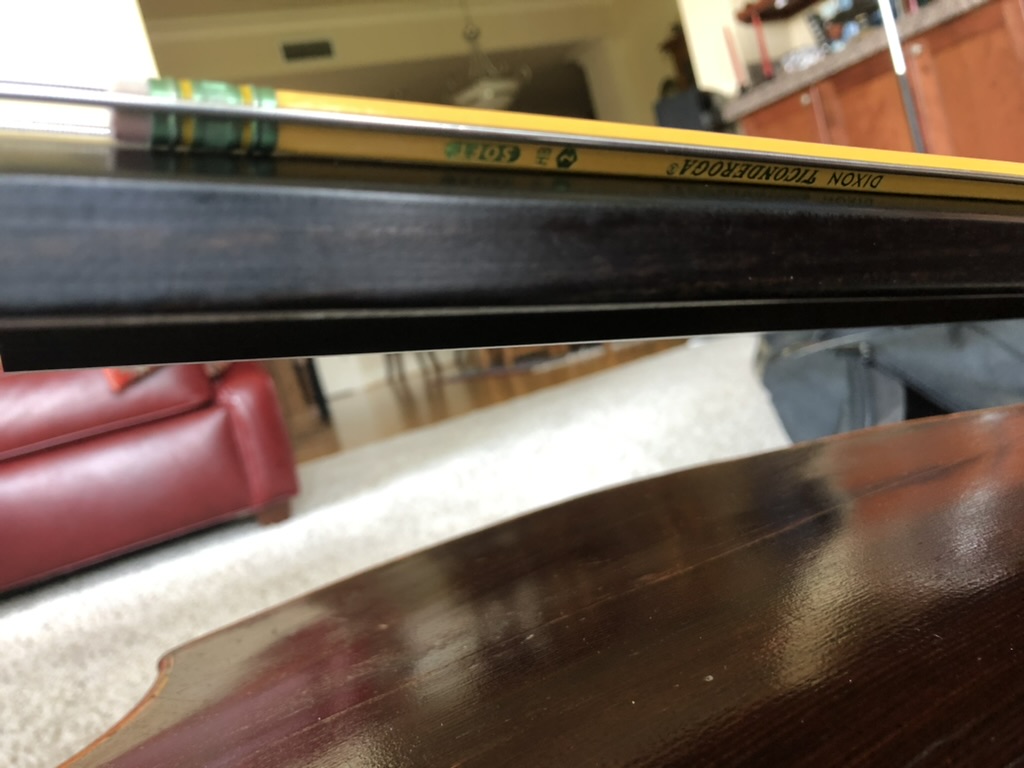
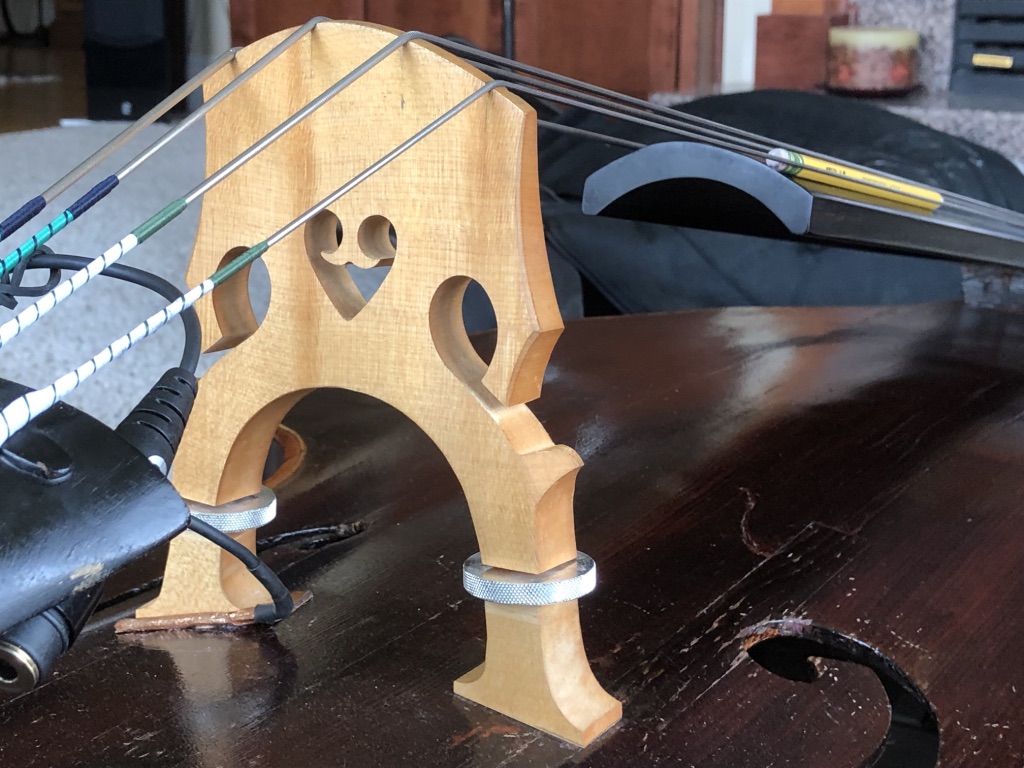
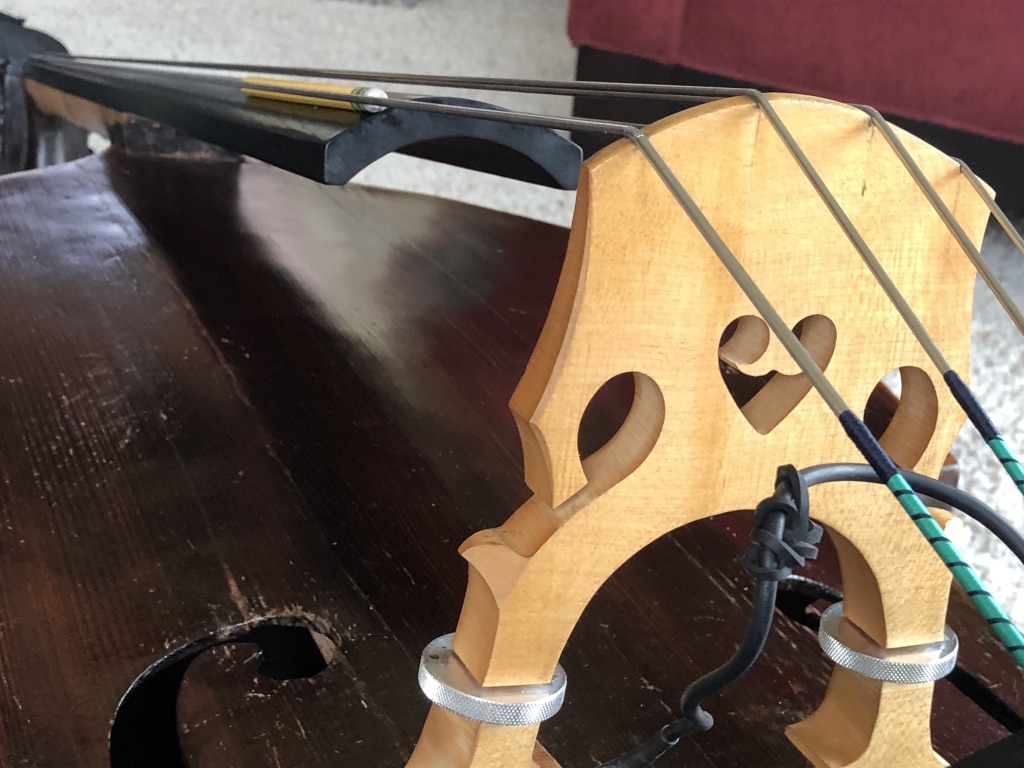
Lay a #2 pencil on the fingerboard parallel to each string (one string at a time) with the eraser of the pencil at the end of the fingerboard nearest the bridge (see the photos below).
In general, the string height should be somewhere within or at the height of the pencil (see photos). My own string height has been around ¾ the pencil height, which is comfortable for me and still allows me to draw the best “beat” (rhythmic feel; pulse) and sound out of the bass. This is a general guideline and you can adjust up or down as you find the best sound and beat for your particular bass. Getting a good beat (and a good sound) is the primary task!
The goal is to have the action high enough to be able to get a good enough chunk of the string with your right hand in order to produce a good, strong beat, but not so high that your hand(s) hurt from the pressure you have to put on the string.
My action has changed over the years, depending on the basses and strings I've used and also on my ability to draw a great sound and beat out of the bass. On many occasions, it has been higher than the pencil measurement shown in the photos. Experience has taught me how to draw a big sound and a great beat out of an instrument with lower action in a more relaxed way. It came with time and much hard work.
Bridge Adjusters
Get adjusters installed on the bridge of your bass so you can adjust the string height (action) as needed. See the photos – the silver wheels are the bridge adjusters. Find a bass luthier in your area who knows how to install adjusters and set up the bass properly (action, strings, bridge, sound post, etc). You might have to travel to a larger city in order to find a good bass luthier. Trust me, it will be worth your while.
The bass community is rather tight-knit; we know each other and we know the best repair and set-up people. The best way to find a good bass luthier is to ask a few of the leading bassists in the closest city to your area where the leading jazz and/or symphony bassists live.
Strings
The most common type/brand of string among jazz players is probably Thomastik/Infeld Spirocore (Medium).
Another common brand is the Evah Pirazzi string (Weich), which is generally a looser, less taught feel than the Spirocores.
Resources
A great book for bass setup & repair:
“The Setup and Repair of the Double Bass for Optimum Sound” by Chuck Traeger with David Brownell and William Merchant
AMPLIFICATION
Pickups
The David Gage Realist Lifeline and the David Gage Realist are both very good. These two pickups have been my choice for many years (I've used others as well).
The Realist Lifeline can be removed somewhat easily for use on different basses (or for thieves).
The Realist can't be easily removed from the bass; once it is installed it should stay installed. In the photos below, the bronze piece under the bridge foot is the Realist pickup element.
Full Circle & Underwood pickups are also common and well-regarded.
Amplifiers
I've been using Gallien Krueger bass amps for many years. They're very dependable, pretty simple to use, and produce a great sound. Aguilar is another popular brand.
Amp Settings
The goal with amplification is to get a great acoustic sound on the unamplified bass and then duplicate it through the amp. Amplify it only as much as necessary to boost the natural sound of the instrument without changing its natural sound coming through the speaker.
If you have a master volume knob and a separate “channel” volume knob, try setting the master at about ½ (or a bit higher) and use the channel volume to adjust your volume level. This gives a warmer sound.
For bass guitar, try setting the master closer to ¾ or full and use less channel volume. This generally gives a cleaner sound for the electric bass.
Set the tone controls to flat. Adjust your tone from “flat” as the starting point. This will add or subtract color, fullness, etc. Match the real bass sound. If the unamplified bass sound is bad, you won't be able to fix it with the amp.
METHOD BOOKS
I've used all three of these extensively and they're all great:
-Simandl New Method for String Bass”, International Edition (2 volumes, starts at the beginning)
-Francois Rabbath “Nouvelle Technique De La Contrebasse”, English Text (3 volumes, starts at the beginning).
“Ron Carter – Comprehensive Bass Method” roncarterjazz.com (more advanced but very important) https://roncarterjazz.com/products/ron-carters-comprehensive-bass-method
GREAT BASSISTS
There are many, but these four are a great place to start:
Paul Chambers
Ray Brown
Ron Carter
Christian McBride
LISTENING
You must listen to this jazz music if you want to learn how to play it! Trying to play this music without regular, focused listening is equivalent to trying to learn a foreign language while sitting in a soundproof booth. Had you not heard your native language beginning when you were a baby and throughout your childhood, you'd have no idea how to speak it now!
These are a few of my favorite bass and rhythm section albums:
-Wes Montgomery and Wynton Kelly - “Smokin' at the Half Note” (Chambers)
-Miles Davis Quintet- “Workin' ”, “Steamin' ”, “Cookin' ”, “Relaxin' “, “Friday & Saturday Nights At The Blackhawk”
(Chambers)
-Oscar Peterson Trio - “The Trio”, “Something Warm”, “Plus One with Clark Terry”, “Reunion Blues”
(Brown)
-Milt Jackson Quintet - “That's The Way It Is”, “That's The Way It Had To Be”
(Brown)
-Jimmy Rowles & Ray Brown - “Tasty”, “As Good As It Gets”
(Brown)
-Miles Davis Quintet - “My Funny Valentine”, “Four And More”, “Miles In Tokyo”, “Miles In Berlin”
(Carter)
-Ron Carter And Rosa Passos - “Entre Amigo
(Carter)
-Chet Baker - “She Was Too Good To Me”
(Carter)
-Ron Carter & Jim Hall - “Alone Together”
(Carter)
-Christian Mc Bride - “Gettin' To It”, “For Tony, Wes, & Oliver”, “New York Time”
(McBride)
-Joe Lovano - “Tenor Legacy”
(McBride)
G String Side
G String Side, Adjusters, David Gage Realist pickup and copper element
E String Side
Feel free to contact me through this website if I can be of help!